Every few months, a headline pops up:
“Companies can’t find the skills they need.”
“Talent gaps are widening.”
“AI is eating jobs faster than we can reskill people.”
All true-ish. And also… incomplete.
Because when you zoom in on most “skills shortages,” you find a quieter, more stubborn diagnosis:
Skills aren’t disappearing. They’re becoming hard to see, hard to trust, and easy to miss in time. That shift matters because it changes what leaders should invest in: not just capability building, but the system that makes capability usable.
Why “Talent Shortage” Is Often a Skills Visibility Crisis
A skills visibility crisis happens when skills exist internally but are too outdated, noisy, or unverified to be usable for decisions.
Most organizations are sitting on a huge reservoir of capability they can’t reliably surface. Skills hide in places formal systems don’t look:
- Hidden in past projects
- Acquired informally
- Developed in lateral roles
- Learned in the margins, then never recorded
- Understated because people don’t self-promote
- Overstated because people don’t self-calibrate
- Lost to time because the last skills survey was 10 months ago
So when leaders say, “We don’t have enough X,” what they often mean is:
“We don’t have enough trusted, current data to know where X exists.”
The invisible bottleneck: skill data throughput
Let’s borrow language from operations.
A supply chain fails in two ways: when supply is truly low, and when supply exists but can’t move through the system fast enough to be usable. Skills fail in the same second way more often than we admit.
Capability already exists in the workforce. What stalls is the pipeline that turns capability into available, decision-grade supply.
The skills supply chain clogs in familiar places:
- Episodic collection
Annual or biannual skills surveys create snapshots that go stale the moment you hit “submit.” - High friction reporting
Long forms, generic taxonomies, and manual updates ask people to stop work to describe work…and do it in HR language, not their own. - Low trust calibration
Self-assessments alone are noisy. Manager assessments alone don’t scale.
Either way, teams quietly stop believing the data. - Taxonomy decay
Skills evolve in projects before they exist in libraries. By the time a new skill is “official,” your org has already been using it for six months.
This is why skill data becomes thin, noisy, and slow to refresh. Throughput collapses first. Scarcity shows up later as the symptom.
How poor skill visibility creates the illusion of scarcity
When visibility is thin, leaders do what humans always do under uncertainty:
- default to external hiring
- overpay for the “obvious” experts
- underuse adjacent talent
- oversubscribe the same internal people
- run broad L&D programs because precision feels impossible
None of this is irrational. It’s what happens when supply is unclear.
The paradox follows naturally: surrounded by talent, still feeling short-staffed.
Scarcity becomes a feeling manufactured by the system — then internalized as truth.
What a modern Skills Intelligence system does
A modern Skills Intelligence system behaves less like a census and more like a living instrument panel. It exists to keep skills visible, trusted, and current enough to power real decisions.
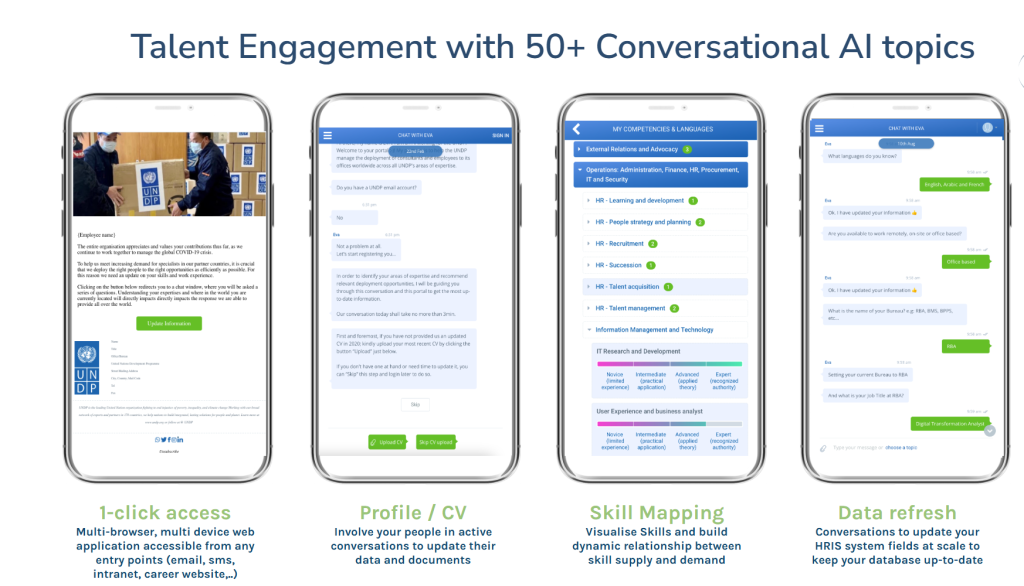
1. Continuous capture, not episodic census
Skills should be collected the way good products collect usage data:
lightweight, frequent, and in the flow of life.
Conversation-led updates, micro-check-ins, contextual prompts — these keep skills current without fatigue. Done well, this turns skills from a yearly chore into a lightweight habit — the way people already update tools, tasks, and workflows.
2. Evidence-backed validation
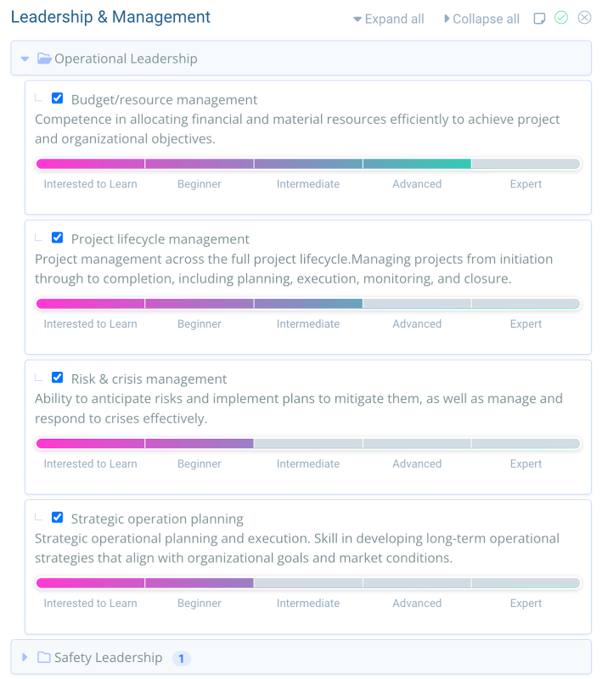
Skills data earns trust when it’s paired with proof:
- recency
- examples
- project context
- peer/manager confirmation
- artifacts (certs, work outputs)
Not everything needs heavy verification. But everything needs confidence scoring.
When evidence exists, the system can attach confidence to each skill. That confidence becomes the real currency for planning.
3. A living skills taxonomy
A skills library should adapt the way the organization adapts:
- absorbing new skills as they appear
- unifying synonyms across teams and geographies
- reflecting regional and functional language
- showing adjacency and overlap between roles
- staying aligned to changing work, not static job titles
Taxonomy is infrastructure. When it updates slowly, every downstream decision — matching, planning, learning — moves on yesterday’s map.
4. Outcomes over paperwork
The success measure isn’t “survey completed.” It’s:
- How fresh is our skills data right now?
- Where are our real gaps?
- How fast can we redeploy talent?
- How accurately can we forecast demand vs supply?
- Are we verifying learning through observed uplift?
A Skills Intelligence system is only useful if it improves decisions.
The compounding lift most leaders underestimate
Here’s what leaders usually underestimate: skill visibility compounds.
Once signals stay current and confidence-weighted, every downstream move gets lighter. Planning sharpens because supply is real. Mobility accelerates because matches are defensible. Learning narrows because gaps are precise. Hiring becomes a targeted last-mile act instead of the default response.
- Workforce planning becomes real-time, not retrospective.
- Internal mobility stops being a campaign and becomes a habit.
- Upskilling moves from “guess-everywhere” to “target-precisely.”
- Hiring becomes a last-mile problem, not the first response.
- Succession planning becomes evidence-based, not “who’s been around longest.”
This is why skill visibility isn’t a nice-to-have data layer. It’s a growth lever across the talent lifecycle.
A useful reset for talent strategy:
Instead of asking, “How do we find more skilled people?”
start asking, “How do we make the skills we already have visible, verifiable, and continuously current?”
Organizations that solve that visibility layer stop operating in permanent triage. They plan with clearer supply, redeploy faster, and invest in learning where it actually moves capability.
If your company feels chronically short on skills, don’t assume capability is missing.
First check whether the system can surface capability in time to use it.
Fix visibility. Build confidence. Keep the pipeline moving.
The shortage narrative starts shrinking in measurable decisions.
How EVA.ai Enables Skills Intelligence
EVA.ai supports Skills Intelligence through three connected capabilities:
- Continuous skills capture through conversational updates and contextual prompts that keep data fresh without survey fatigue.
- Evidence-weighted validation and confidence scoring, so leaders can trust skill supply for planning and redeployment.
- A living skills taxonomy and skills graph that absorbs emerging skills, aligns synonyms, and shows adjacency across roles.
Together, these power real-time workforce planning, internal talent marketplaces, targeted skill gap analytics, and defensible internal mobility decisions — before external hiring becomes the default.